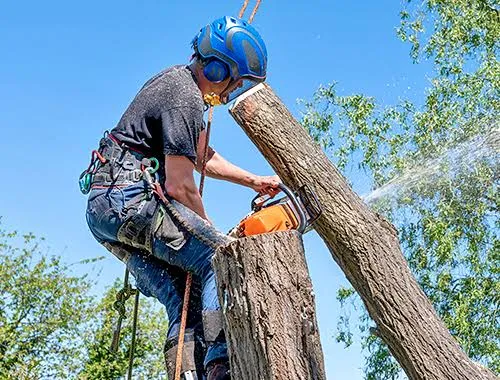
Most trees that fail were showing signs for years. The homeowner just didn't know what they were looking at.
That's the frustrating part about tree removal in Massachusetts. By the time a tree comes down on its own, it usually takes something with it. A fence, a car, a section of roof. And almost always, somebody walking the property a year earlier could have spotted it.
You don't need to be an arborist to catch the obvious ones. Dead limbs are dead limbs. A trunk leaning harder every season is a trunk leaning harder every season. But some of the real warning signs look like nothing at all from a distance. Those are the ones that put a tree on the ground during the first heavy wind of the season.
So here's what to walk out and look at on your own property. Start down at the ground and work your way up from there.
Start at the Base
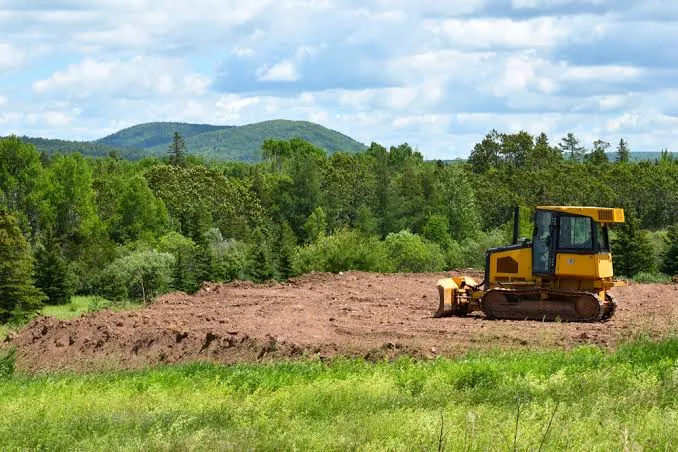
The root flare is where the trunk widens out as it meets the ground. That's the first place to look.
If the flare is gone and the trunk goes into the soil like a fence post, something is wrong. Either the tree got buried too deep or the roots have decayed underneath. Both mean the tree isn't anchored the way it looks like it is.
Check for mushrooms and shelf fungus growing at the base or on exposed roots. Fungus there means decay inside the wood. By the time it fruits on the outside, the damage underneath is well along.
Soil lifting or cracking on one side of the trunk is the serious one. That's the root plate moving. A tree doing that needs to come down.
Then Read the Trunk
Walk around the whole trunk. You're looking for anything that breaks the smooth line of the wood.
Deep vertical cracks matter, especially if you find two running down opposite sides. Cavities and hollow sections matter too, though a hollow trunk isn't automatically a dead tree. What counts is how much solid wood is left around the hollow.
Bark falling off in sheets with nothing living underneath means that section is dead. A little on one side may be old damage that healed. Around most of the trunk, the tree is finished.
Lean is the one everybody notices and the one everybody reads wrong. A tree that's leaned the same way for twenty years is usually fine. A tree that started leaning last season is not.
Look Up at the Canopy
The canopy tells you what the tree is doing right now.
Compare it to the trees around it. If everything else leafed out and this one came in thin and patchy, the tree is struggling. Dead branches in the upper crown are a bad sign, worse than dead branches low on the trunk.
Look for limbs with no bark and no small twigs on the ends. Those are already dead and they'll come down eventually. The only question is whether they come down on their schedule or on yours.
Check where the big limbs meet the trunk. A tight V shaped joint with bark pinched inside it is a weak union. Those split under snow load, and winter here gives them plenty of chances.
Where the Tree Stands Changes Everything

A dying tree in the back corner of a large lot is one problem. The same tree over the driveway is another.
Location decides urgency. Same tree, same condition, completely different call depending on what sits underneath it. A house, a garage, a play set, a power line or the neighbor's fence all raise the stakes considerably.
Distance matters too. Rough rule of thumb. If the tree is closer to the house than it is tall, the house sits inside the fall zone.
None of this means every leaning tree comes down. Plenty get saved with pruning or cabling. But a tree with structural problems standing over something you care about is worth a look. Better now than after the next storm decides for you. If the whole lot has gone wild, that is land clearing instead.